 Yogurt Atelier
How Yogurt Traveled
Following fermented milk across regions, languages and kitchens, without pretending to know where it all began.

Ask where yogurt came from and you will often be handed a tidy answer: a single place, a single people, a single moment. The honest answer is messier and more interesting. Fermented milk traditions turn up in many parts of the world, and people moved, traded and married across those regions for thousands of years. This article follows the trail of how the idea spread, and it is careful to say where the trail goes cold.
Clues instead of maps
Early dairying is documented in several regions, and herding peoples across Asia, the Middle East, Europe and Africa all kept animals for milk. Soured milk would have appeared wherever fresh milk sat warm for long enough, so it is entirely possible that people discovered it independently in more than one place. That is the first reason a single-origin story is unreliable: similar foods can arise separately from the same simple conditions. The second reason is that milk products leave few traces. Pots, residues and written recipes tell us that milk was handled, but they rarely tell us whether the result was yogurt, a drinking sour milk or a fresh cheese.
Starters that traveled well
Some things do move easily with people. A small amount of an active culture can be carried in a pot, a skin bag or a cloth, and it can be used to start a new batch anywhere there is milk and a warm corner. Herders following their animals, traders on long routes and families relocating all had reason to bring such a starter along. Shared methods in neighboring regions, such as setting milk with a spoonful of the previous batch, suggest exchange of practice even where records are silent. We should still describe this as likely rather than proven for any particular route.
Words that moved
Language gives firmer evidence than guesswork about routes. The English word "yogurt" was borrowed from Turkish, and versions of the Turkish word appear in several other European languages as well. But many places kept their own names for their own fermented milks, among them dahi, mast, laban, matsoni, kefir and skyr. Different names for similar foods are a reminder that traditions developed in parallel as well as by borrowing. A word can travel without the recipe, and a recipe can travel without the word.
Changing with every kitchen
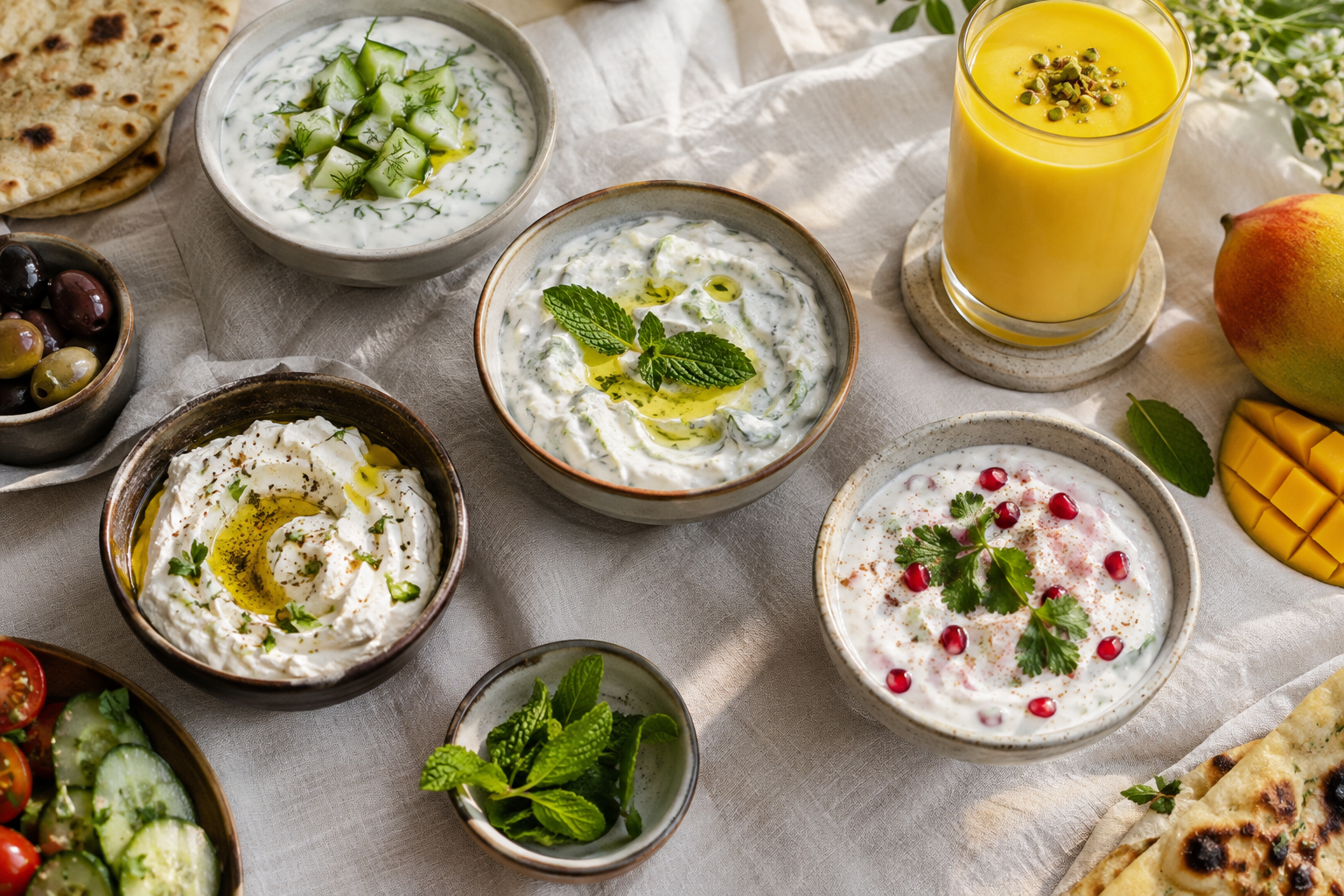
As a food moved, it changed. Cooks adjusted it to the milk they had, whether cow, sheep, goat, buffalo or camel, and to the climate they lived in. Some communities strained their yogurt into thick, spreadable forms. Others thinned it into drinks or dried it into hard balls that could be stored and later softened in water. Yogurt became a sauce in one kitchen, a soup base in another and a dessert in a third. Each version is a local answer to local conditions rather than a corrupted copy of an original.
From migration to supermarkets
In the nineteenth and twentieth centuries, migration and industry carried yogurt into places where it had been little known. Families who emigrated took their cooking with them. Food producers in Europe and North America began making yogurt in factories, adding fruit, sweetening it and packaging it in small cups. Refrigerated transport made it possible to sell a fresh cultured food far from where it was made. For many shoppers today, the first yogurt they meet is a flavored cup, not the plain household versions that came before it.
What the trail tells us
The most reliable lesson from yogurt's travels is humility. We can say that fermented milk is old, widespread and shared among many peoples. We can say that the English word came from Turkish. We cannot say, with the evidence available, who made the first batch or exactly how it crossed any given border. Next time you stir a spoonful of plain yogurt into warm milk, you are joining a practice that has been handed along countless times, by people whose names we will never know.
Fermented milk is shared heritage, not one nation's invention.
Bring your curiosity
into the kitchen.
Explore guided preparation, fermentation tracking and yogurt recipes in Yogurt Atelier for iPhone.
 Coming soon to the App Store.