 Yogurt Atelier
Meet the Cultures
The tiny helpers behind every spoonful.
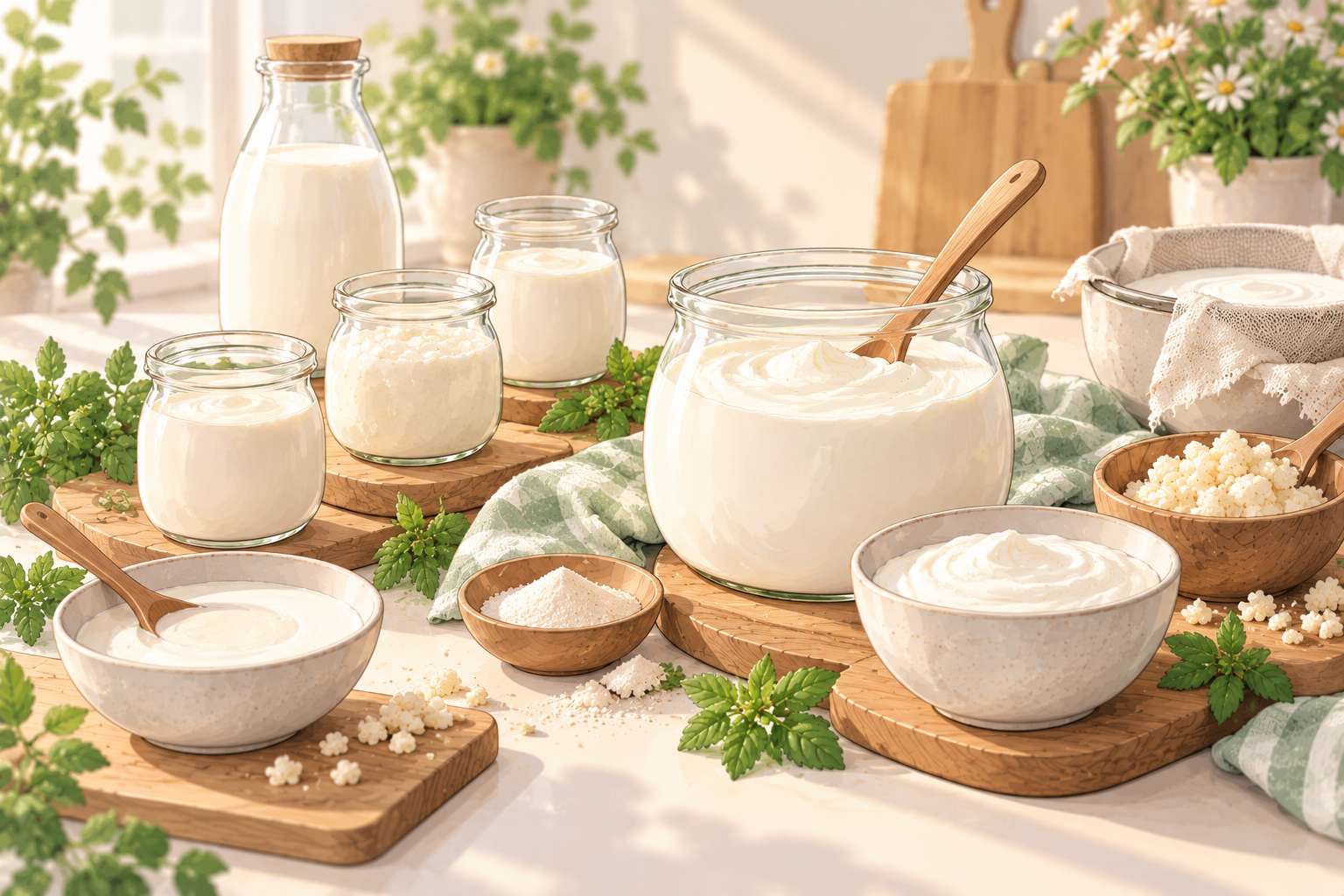
Yogurt is milk that has been fermented by friendly bacteria. You cannot see them, but they do all the work: they feed on the milk's natural sugar, lactose, and produce lactic acid. That acid gives yogurt its gentle tang and its thicker body. Understanding who these helpers are makes the whole process less mysterious, and it explains many of the choices in a recipe.
What the cultures do
As the bacteria multiply, the milk gradually becomes more acidic. That rising acidity changes the milk proteins, which gather together into a soft network that holds the liquid in place. The result is the familiar spoonable texture. The same acid is responsible for the pleasantly sharp taste, and the longer fermentation goes on, the more of it there is.
The classic duo
Traditional yogurt is made with two types of bacteria, Streptococcus thermophilus and Lactobacillus delbrueckii subsp. bulgaricus. They are often described as working as a team, with each helping the other to grow in warm milk. International standards for fermented milks define yogurt by this pair, and require the cultures to be alive and abundant in the product up to its date of minimum durability.
Your starter is just a spoonful of yogurt that is already full of live cultures.
Other cultures
Not every yogurt-like product uses that exact pair. The same international standard also describes an alternative yogurt made with Streptococcus thermophilus and other Lactobacillus species, and plant-based yogurts use cultures chosen for plant milks. Some starter packets from shops contain blends of their own, with instructions that you should follow in preference to general rules.
Why warmth matters
Cultures work best in a comfortably warm range, a little above body temperature for the classic duo. If the milk is too cool they slow down, and if it is too hot they can be harmed. That is why recipes have you cool heated milk before adding the starter, and why a steady, warm spot matters for the hours that follow. The guides in the Make tab give the specific temperatures from extension-service guidance.
Choosing and keeping a starter
The easiest starter is a spoonful of plain yogurt that contains live cultures. Check the label for wording about live and active cultures, and choose one that is unflavored. Fresh yogurt tends to work best. Many people save a few spoonfuls from a good batch to start the next, and that works for a while. Over time, the flavor may drift, and if batches begin to set poorly, it is sensible to begin again with a fresh starter.
Live versus heat-treated
Some yogurts are heat-treated after fermentation, which stops the cultures. Those can taste fine, but they will not work as a starter, because the bacteria are no longer alive. This is one reason the label matters, and why a store-bought tub that mentions live cultures is the better choice for starting a batch.
When to start over
If a batch smells sharp, rotten or like nail polish, shows mold, or looks pink or slimy, throw it away and begin again with fresh milk and a fresh starter. A healthy culture is quietly doing its job; you do not need to taste a questionable batch to decide what to do.
Bring your curiosity
into the kitchen.
Explore guided preparation, fermentation tracking and yogurt recipes in Yogurt Atelier for iPhone.
 Coming soon to the App Store.