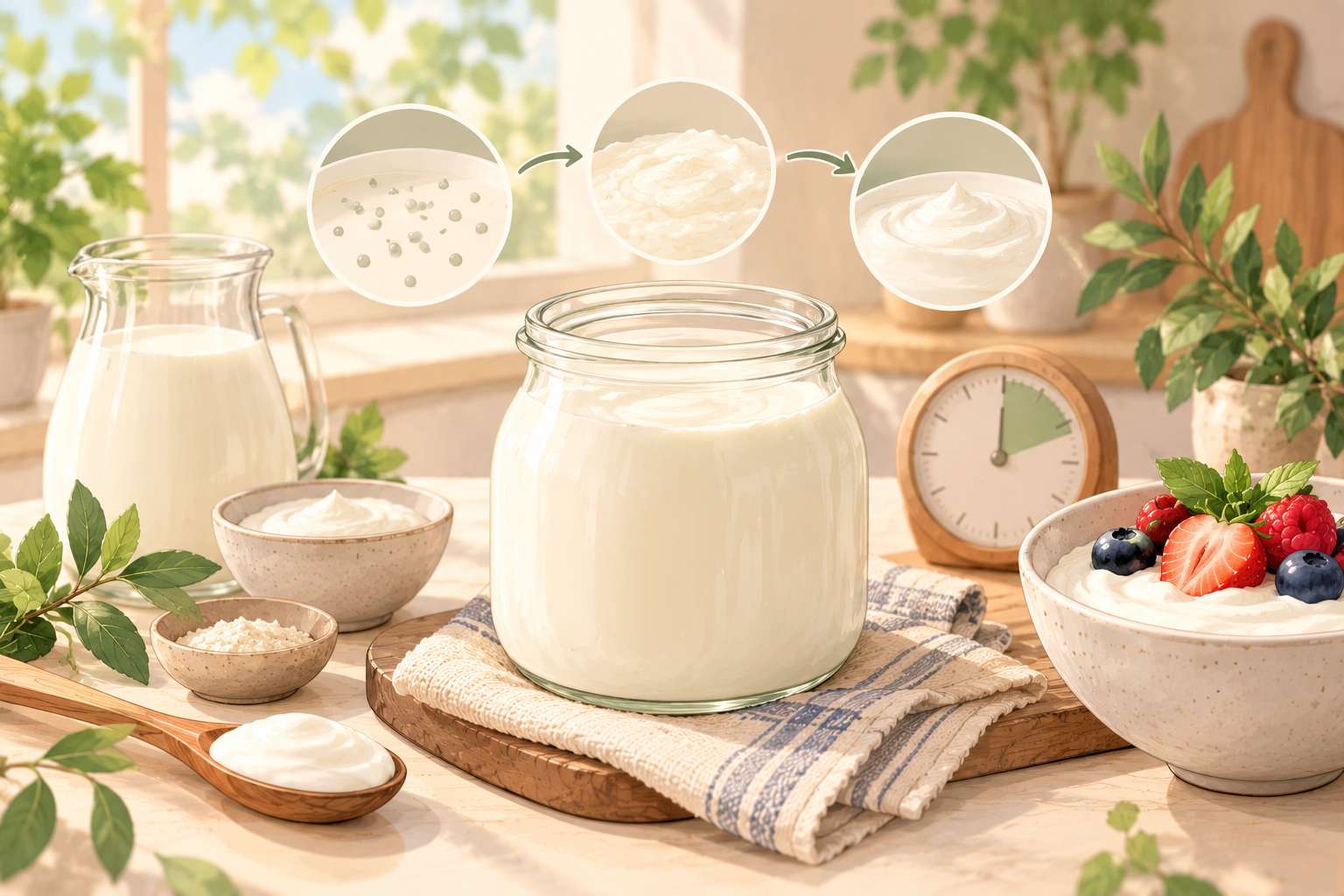
 Yogurt Atelier
Acid and the Protein Gel
How bacteria, acid and milk protein turn a liquid into a spoonable set.
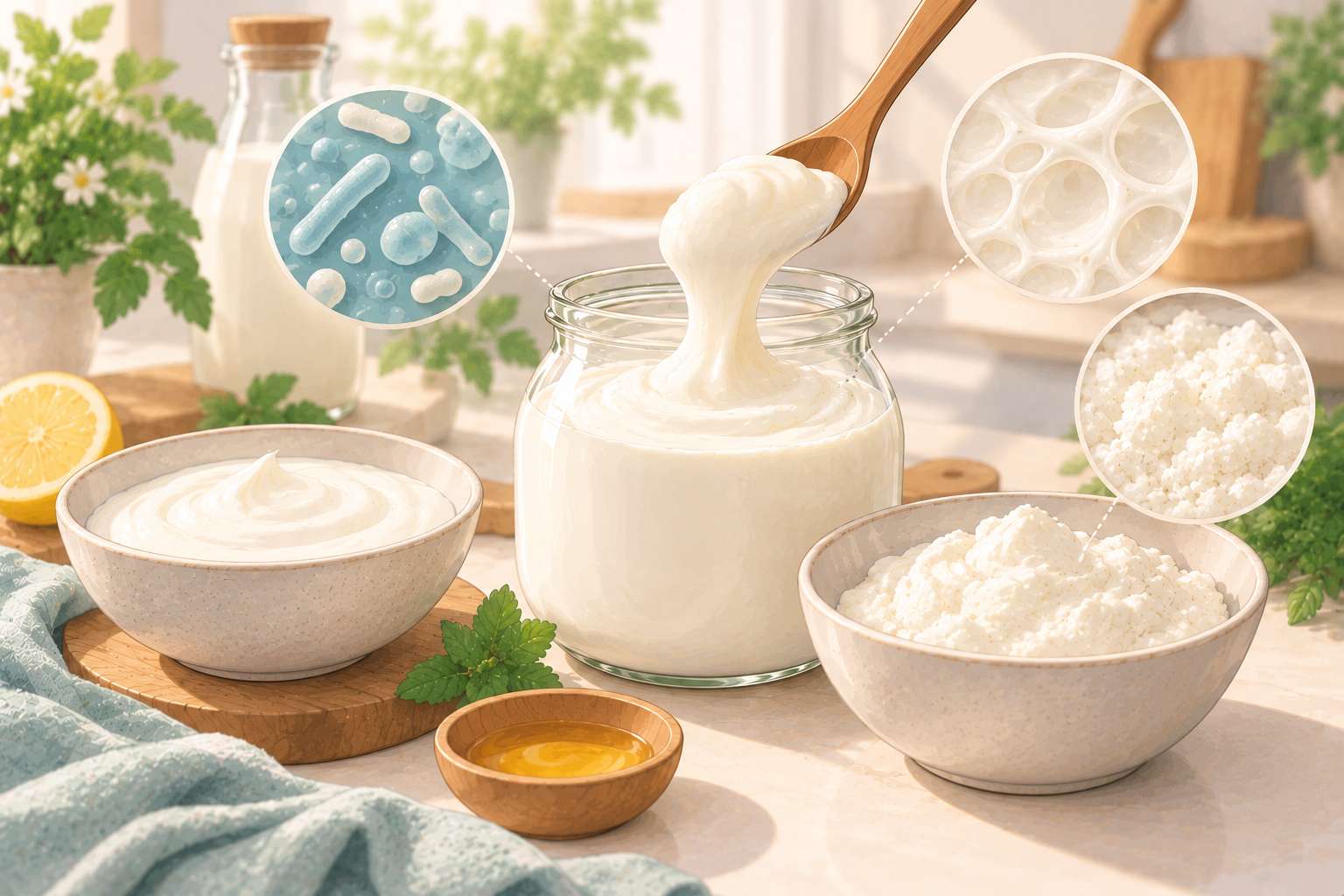
Milk is a liquid, and yogurt is a soft solid. Between the two, nothing is added except time, warmth and a few billion helpers. What makes the change happen is a simple chain of events: bacteria make acid, acid changes milk protein, and the changed protein links together into a network. This article walks through that chain in plain language.
Protein in milk
Most of the protein in milk is casein, and caseins travel in tiny clusters called micelles, which stay separate and suspended in fresh milk. Each micelle carries a surface that keeps neighbors from sticking together. That is why milk pours: the protein is dispersed and not connected. Whey proteins, the other main group, are dissolved in the liquid and behave differently, as we see below.
Bacteria make acid
The starter bacteria feed on lactose, the main sugar in milk, and produce lactic acid. As acid accumulates, the milk becomes more acidic and the pH falls. The bacteria are working at a pace set by temperature and time, but the underlying principle is just chemistry: more acid, lower pH. The same acid also gives yogurt its characteristic tang.
Acid reaches the casein
Casein micelles have an isoelectric point around pH 4.6, which is the acidity at which their surface charge is balanced and they lose the stability that kept them apart. As the milk approaches that point, the micelles start to stick to one another. They link into chains and clusters, which join into a three-dimensional network that traps the liquid in its pockets. That network is the gel. What you see as yogurt is mostly water held inside a delicate protein mesh.
Why heating helps
Heat plays an important earlier role. When milk is heated above about 70°C, whey proteins unfold, or denature, and attach to the surface of casein micelles. Research indicates that this changes how the gel forms: the micelles with attached whey proteins begin to link at a higher pH, and the final gel is firmer. This is why recipes ask you to heat the milk before adding the starter. It is not only about warmth, it is about reshaping the protein.
Disturbing the gel
Because the gel is a network of connected protein, anything that interferes with it changes the result. Stirring a freshly formed gel breaks links and can give a thinner, smoother texture. Moving the pot while it sets may also disturb the forming network. These are general observations from dairy science, and they are one reason cooks leave a batch undisturbed.
Putting it together
Seen this way, yogurt making is a controlled chain of events: warm milk, active bacteria, falling pH, and a protein network that traps water. Every tip in a recipe, from heating the milk to leaving the jar still, serves one of those steps. Understanding the mechanism makes it easier to troubleshoot, adjust and trust the process.
Acid brings the protein together; the network holds the water.
Bring your curiosity
into the kitchen.
Explore guided preparation, fermentation tracking and yogurt recipes in Yogurt Atelier for iPhone.
 Coming soon to the App Store.